
Early May 2014 saw the Infrastructure team locate a cracked fishplate during a routine track inspection. The fault was repaired before the fracture could develop into a broken fishplate with help from the operations department, which ensured no delays or reduced service occurred during the Teddy Bears’ event.
Routine permanent way maintenance continued throughout the month, such as greasing fishplates, gapping rail joints, inspecting the line side banks & cuttings, responding to other departments’ observations / concerns, public relations with people on the Brampton Valley Way and changing some defective track insulators.
Routine signalling maintenance included oiling and greasing the external signalling equipment and lever frames / interlocking, testing signalling power supplies at the various line side locations and signal boxes and checks on point detection and facing point lock tolerances
An independent inspection of Bridge 11 & 13 has been carried out, funded by NSRL. The final report is awaited from the inspector in due course.
Also funded by NSRL (in April 2014) the weed killing contractors paid a second visit to sort out the areas that had seen significant weed regrowth. A different mix of weed killer was employed in less than ideal weather conditions. Initial indications are that the second application is having an effect.
Other than routine work, the main achievements in May are:
- The completion of Boughton No.2’s lever refurbishment program. All 30 levers have been installed along with the internal cranks and pulleys. Thanks is given to David Millard for the use of a heavy duty SDS plus drill, to drill the hardwood timbers inside & outside the box. (See photos). Looking back at a photo from 2009 it shows how much has been achieved by those members who have been in / worked with the Infrastructure Team
-
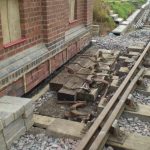
- 2009, the initial laying out of the external crank bench. Note only the concrete foundation castings are in place, the hardwood timber was purchased and installed later. The cranks shown have been refurbished and repainted prior to final installation.
-
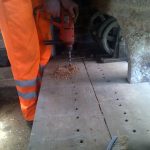
- David Millard using a SDS plus drill with auger drill bit, to drill holes to screw or bolt down the vertical pulleys (for signal wire/chain) or vertical cranks (for point rodding). Photo by Graham Peacock
-
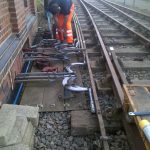
- David Millard drilling the holes to bolt/screw down the external crank for lever 13. Photo by Graham Peacock
-

- A close view of the holes being drilled to install lever 13’s external crank. Note the bricked up lead out with draught exclusion measures behind the driller’s arms Photo by Graham Peacock
-
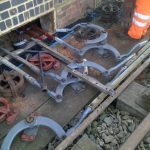
- Cranks for lever 13 & 14 installed. Note the triple pulley with the chain on the top wheel that is now connected to Signal BG4. The bricked up lead out box reduces draughts for the signaller. The use of water pipe as a chain/wire conduit reduces the draughts and the chance of animals entering the box. Photo by Graham Peacock
-
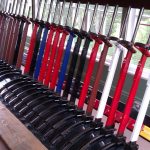
- The Lever frame inside Boughton No2 box just after the installation of lever 1, the last lever to be refurbished. Levers have been sourced from Croft & Woburn signal boxes. Photo by Chris Coulston
-
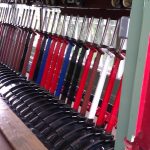
- Boughton No.2 refurbished levers looking from the door. Photo by Chris Coulston
- Aligning the ex-Croft locking frame uprights so that the complete 30 lever frame is completely level enabling the full length locking bars to travel freely once operational.
-
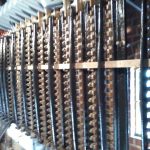
- Boughton No2 Locking Frame where the first bars have been inserted into the newly aligned racks for levers 1-15 on 23rd March 2014 Note the final alignment of the racks & uprights was carried out in May 2014
-
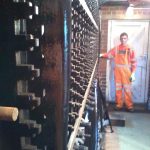
- James Coulston holding the first full length locking bar to be fitted to all 30 locking racks. 06th April 2014 Note the final alignment of the racks & uprights was carried out in May 2014
- Facilitating, along with other departments, a successful rail accident investigation course in the second half of the month.
Whilst the use of the Boughton extension has always been a key requirement of the rail accident investigation course, progress towards the completion of the signalling has added further realism to the simulation being run. The advanced state of the works has enabled the signal box to be used directly this time around.